4th November:
I jumped at the chance to go to Ramsey Island with Andy Tweed for the Yellow-rumped Warbler that had been found and we travelled down to St Davids overnight and by 8.15am we were waiting our turn to cross to the barren looking island managed by the RSPB.
Birds were definitely on the move
with hundreds of Chaffinches and Greenfinches going south along with Siskins, Linnets,
Starlings, Meadow Pipits, Skylarks and a few Thrushes while Yellowhammers and
Reed Buntings may have been local birds. A lone Swallow hawked around us and
small parties of Snipe twisted through the sky while a female Peregrine was on almost
constant view as she patrolled the coast.
The trip across what is reputed to be once of the most
dangerous stretches of whirlpool infested water in eth UK was 12 up in an RNLI
Zodiac. It twisted and turned around the swirling water as a straight line
could not be taken across and I think we were airborne for most of the journey.
In no time at all we were moored against the small quay when
a radio crackled into life to say that they had just re-found the bird. A cheer
went up! Ten minutes later after a short uphill walk we were all drooling over
this exquisite American Warbler as it fed gracefully in the Ivy and grasses
that covered the vertical walls of its chosen cliff gully. The yellow on the
shoulders and rump was surprisingly vivid and there was grey showing through so
perhaps it was first-winter male? The bird called frequently, especially in
flight - a hard metallic ‘chick’ note.
 |
| Yellow-rumped Warbler #412 |
I wandered off to have a look at the innumerable and very
tame Choughs and like on the mainland the passerine passage was still notable
and made up of the same species. I was
also fortunate enough to put up two Richard’s Pipits from the long grass but
they headed off calling towards the other side of the island with some Skylarks
while a single Snow Bunting over head was also a pleasing discovery.
After popping back for another look at the Yellow-rump, we
pottered back down to the quay, downed a coffee in the café and caught the
first Zodiac back to the mainland and we did not mind getting wet on the way
back. With nothing else to chase, we headed home happy. November is always full of surprises.

6th November:
Landguard does it again! This time
a large Pipit present since Friday was identified as a Blyth’s and it was guaranteed
a good turn out. As Pete, Steve and I
arrived at 7.30am it was obvious from the assembled mass that the bird was still
present. Minutes later the bird was in the bag. A strikingly small Large Pipit
being only a little bigger than a Rock Pipit and over the next hour or so
excellent views were had as it fed on the short grass.
 |
| Blyth’s Pipit - I have a horrible feeling that I had ticked the Portland Pipit! |
Quite a few other birds were on the move including two high
flying Bewick’s Swans, some Brent Geese, Wigeon and lots of Wood Pigeons. There were very few small birds but we did
see a mind numbingly bright Firecrest and yet another Pallas’s Warbler while an
adult Med Gull was a nice surprise.
After another look at the Pipit and a Long-eared owl that has
been found in the Tamarisks, we decided to head off to Colne Point for another
look at the Rough-legged Buzzard. It was on the seawall once again and we had
the most astonishing views as it hunted in front of us and we saw it
successfully catch three Voles. Three Short-eared Owls were seen alongside the
road as we drove back out – the first of the autumn.
On to Abberton which was disappointing given the low water levels
but we did find 12 Ruff and four Spotted Redshanks but no special Grebes. There
were 35 Bewick’s Swans by the Island and a small group of Goldeneye hinted at
winter. With the temperature falling and the light failing we called it a day.
11th November:
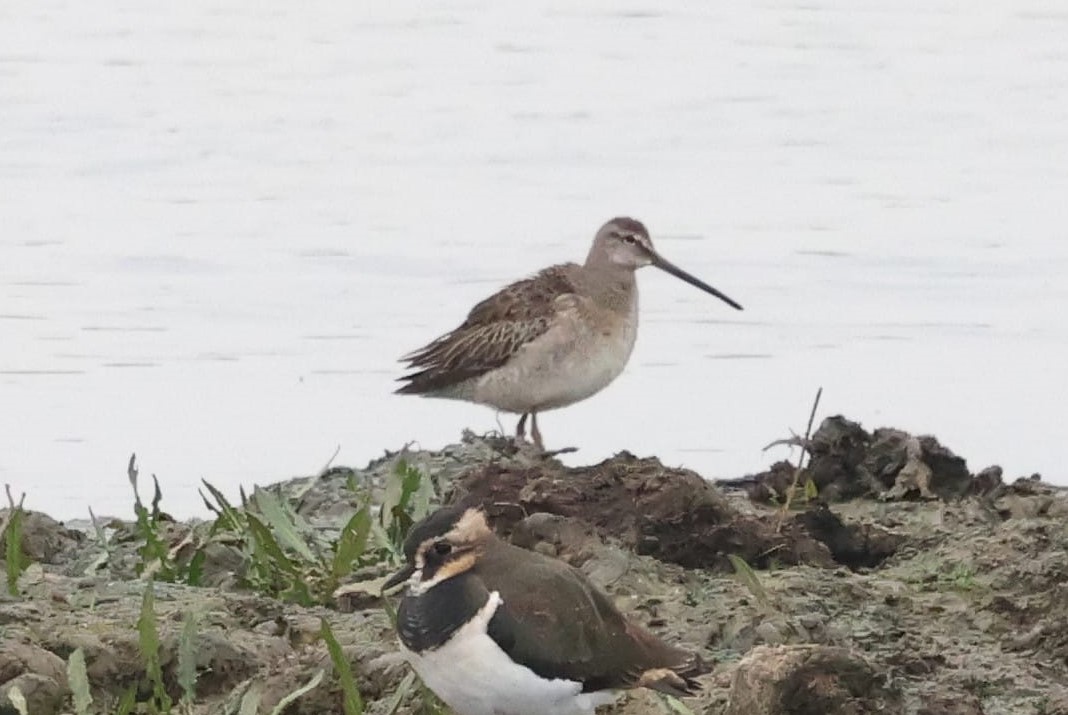
A jaunt with Pete down to north Kent to visit Cliffe and fortunately the Short-toed Lark was still present and after some faffing around fantastic views were had. A fairly dark and well marked individual with a prominent neck patch and greater covert bar. It was feeding with many Skylarks and if taken easily then it was very approachable. [Eds: I seem to remember that Pete was in the car at the point and I was the only birder out looking at it].
On occasion it would take flight and disappear
into the sky until it became a dot but would always soon plummet back to its
favoured patch giving little chip and chirrup calls. In fact Short-tailed Lark would probably be a
more apt name for this metatarsally challenged species.
 |
| Short-toed Lark |
Dozens of Little Grebes were on the main pit but there were
very few duck. An adult Little Gull flew over croaking and two Pinkfeet and a
Brent Goose were good records. The bushes held Stonechats, Reed Buntings and
Meadow Pipits and two tumbling Short-eared Owls put on a good show.
On to the Alpha Pool but the sub-adult Greater Flamingo was
not with his Chilean buddy that he had picked up from Titchwell but was out on
the Thameside mudflats in the company of a host of waders that included 50
Avocets.
The Flamingo was dirty white in colour with pinky grey legs
and bill and even obliged us with a fly round showing the bright red upper and
under wing coverts. After watching some Fieldfares and having lunch we came
home.
 |
| Greater Flamingo |
[Eds: This Greater Flamingo was the third I had seen in just
four years with a 1st year bird at Elmley and a full adult at
Minsmere in 1990 and then this bird which, if memory serves, toured around with
and without the Chilean (which had been around for years) for several years I
seem to recall seeing it at Breydon and Abberton. As for origin; you know me well enough to be
un fussed by such things. Was there any
evidence of them being escapees? Could they have got here? I just enjoyed seeing
them in a wild British setting.]
13th November:
Back to Kent with Pete and ted on a much colder and more
blustery day. We avoided Cliffe and headed along the Medway towards Funton
Creek passing the expected Fieldfares in the orchards on the way and lots of
Pintail, waders, some Greylags and two Marsh Harriers from the layby. Harty was as good as ever with two ringtail Hen
Harriers, four female and a male Marsh Harrier and a Sheppey first for me – a Rough-legged
Buzzard which was quite content to hop around searching for worms. [Eds: Note
that back then there were no Common Buzzards on the island – how things change]
Only a small number of White-fronts and two Bewick’s Swans
were seen but the Golden Plover flock was huge and we found two Ruff with them. The rest of the day was spent at Shellness
where we found a Snow Bunting but no Shorelarks and back near the car a female
Merlin dashed through and two young immature male Hen Harriers played together
in the wind.
20th November:
Can’t seem to keep away from the place – this time to
Seasalter directly opposite Shellness. A
Tawny Pipit present since the weekend had unsurprisingly turned into another
Blyth’s Pipit. As we arrived after a long walk they performed the only organised
flush of the day and up came a mediumly large buffy Pipit with a shortish tail
and white tail sides. Hard chep and spreep calls were heard.
Ian and I trudged back finding two tame Snow Buntings and a
flock of Linnet searching for seeds on the beach. We headed to Harty – if only
there was a ferry across the Swale where it was much the same as last Sunday although
double the number of Marsh Harriers and far better views of the Rough-legged
Buzzard were had.
29th November:
Surely one of the most ludicrous day trips I have ever
undertaken – Inverness and back for Britain’s second Grey-tailed Tattler. I left Brentwood with Kettle and the Webbs
and started on the ten hour drive and 650 miles later we arrived at the small
town of Burghead on the shores of the Moray Firth. [Eds: I seem to recall some
atrocious driving conditions on the latter sections with point blank fog that
had us driving down the middle of the A9 with the white line in the middle of
the car to help us stay on the road]
It was 8.15am and light enough to 250 assembled birders and
almost immediately the news came through that it had been found ¾ mile up the
coast so off we trotted [Eds: I assume this means we used our legs?] and soon
had the Tattler in view as it fed in the small tidal pools along the rocky
coastline. A delicate grey wader, seemingly larger and more stocky than a
Redshank but constructed on the same Tringa-like plan. The scapulars and wing feathers were all dotted
white along the edges denoting a first-winter. A single shank-like call was heard.
 |
| Grey-tailed Tattler - from the late Mike McDonnell |
 |
| Grey-tailed Tattler - its says #413 |
 |
| Marcus Lawson and LGRE get a name check... |
Tattler aside, there was plenty to look at on the Firth with hundreds of smart Long-tailed Ducks, a scattering of Velvet and Common Scoters, Eider, Great Northern and Red-throated Divers and Auks. A flock of 21 Goosander whizzed through and there were also Mergansers and many Cormorants and Shags around the outfall.
The walk back to the car on a now beautifully clear crisp
day added three Whooper Swans while back at the harbour the light was wrong to
look at the Findhorn Scoter flock and so after watching more Long-tailed Ducks
and a Red-necked Grebe within the harbour itself we moved to better locale.
With daylight good but time at a premium we headed east to
noisy Lossiemouth where the sound of jets taking off was amazing. Fortunately
the male King Eider still present albeit at a fair distance but was typically
gaudy and very pink fronted. My first male since 1990. Two Black Guillemots were found after
diligent searching by Kettle.
 |
| King Eider |
Back west to the other side of Burghead to Findhorn where
the male Surf Scoter was seen upon arrival with his chosen Velvet Scoter flock
and like the King Eider, my first for four years. The light was so good that
the white eyes, red legs and every detail of that huge bill could be seen. Often swan very low in the water. The Velvets
were equally smart and three Black-throated Divers paddled together not far
offshore.
 |
| Surf Scoter |
With the weather still holding we opted to go south and try
Speyside passing Pink-feet and Greylags on the way. Grantown was so peaceful that for once, I
though the chances of Capercaillie were quite high. The four of us spent the
last couple of hours quietly walking the tracks through the woods. Crested Tits
churred all around us and with patience showed really well. Red Squirrels and
Roe Deer were seen and then suddenly a female Caper crashed out of tree and
firmly took my attention as she zoomed away of thrumming wings! Magnificent!
A Tawny Owl came up out of the heather shortly afterwards
which was a pleasant and surprising addition to the day. It perched up fully in the open on a pine
limb and tried to make itself look more like a stretched Long-eared rather than
a rotund Tawny.
After restocking with snacking supplies in Grantown and fully
satisfied with the day’s work, started to head back down the A9 passing some
stunning glacial features on the way, I am so much more aware of the landscape
around me now. It may not have helped me get a career yet but my degree sure opened my eyes to the
complexity of the British countryside. Tired but on an ornithological high, I
drifted off and smiled the whole way home.


.JPG)
.JPG)
%20(2).JPG)
.JPG)

.JPG)
.JPG)
.JPG)
.JPG)
.JPG)
.JPG)
.JPG)
.JPG)
.JPG)
.JPG)
.JPG)
.JPG)
.JPG)
.JPG)
.JPG)
.JPG)
.JPG)
.JPG)
.JPG)
.JPG)
.JPG)
.JPG)
.JPG)
.JPG)
.JPG)
.JPG)
.JPG)
.JPG)