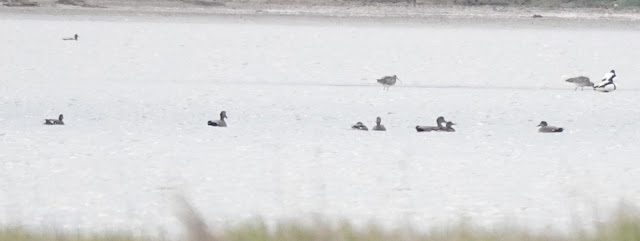
A few hours post-breakfast to poodle around Lotzaria and the
saltpans before heading back to Anaxos. Over 100 Cormorants (196 in fact) left
the Tsiknias as I arrived and I pitied any fish that were previously just
avoiding the two Great White Egrets, Grey Herons and four Spoonbills.
 |
| Cormorants |
 |
| Spoonbills |
A male Hen Harrier was acrobatically trying to catch Meadow
Pipits and Skylarks just beyond the Tsiknias Lower Ford which was still full of
Chiffchaffs and several Reed Buntings and there were now three Ruff including a
smart white male. Two Dunnocks were grovelling around the edges and were the first I had actually seen well!
 |
| Hen Harrier |
 |
| Common Chiffchaff |
 |
| Reed Bunting |
 |
| Ruff |
The Long-legged Buzzard perched up nicely on one of its
regular poles and two Marsh Harriers flushed a wondrous flock of Skylarks, Corn
Buntings, Pipits and Finches.
 |
| Long-legged Buzzard |
 |
| Corn Bunting |
It was very grey and rain was approaching from the north
west where Mt Olympus had already disappeared from view but a last look from
the Alykes Sheepfields gave me a nice flyby from two female Mergansers and
Great Crested Grebes bobbed offshore with 13 Sandwich Terns fishing amongst
them. A male Black Redstart popped up on the fence and the Serins were still feeding on the racecourse.
 |
| Kestrel |
 |
| Black Redstart |
 |
| Curlew - note the clean white underwings |
 |
| Beach birds |
 |
| Great Crested Grebes |
 |
Red-breasted Merganser
|
 |
| Sandwich Terns |
After a chat with the Coastguards who thought birding in
March was hilarious, I bumped back, said goodbye to the Ruddy Shelducks and
'mingos and drove up towards Anaxos.
 |
| Ruddy Shelducks |
 |
| Final Flamingo |
 |
| Magnificent Lesvos Rams - or small Star Wars Bantha? |
I even stopped at the Kalloni Raptor Watchpoint Bandstand
but alas there were only 45 tumbling Ravens and not a Woodpigeon in sight!
 |
| Kalloni RWP |
Twenty minutes at Perasma where a Green Sandpiper fed round
the edge and the Long-legged and Common Buzzards were still tussling and then a
final Black Redstart at Kavaki before the icy rain became a steady deluge.
 |
| Perasma |
 |
| Kavaki |
A smooth airport run with Alison and then off on the Olympic
twinprop to Athens where the weather was somewhat better for the lay over
before the flight back to Blighty and the train back across London. I arrived home at the equivalent and 3am on
the Saturday morning.
And so, some thoughts… It appears that very few western
European birders have ever really been out to the island at this time of year
and although several people commented that I could have seen most of my new species
(and in fact many of the others) on a day out in Kent or Essex, there is no
substitute for a bit of exploring and in that respect it would be no different
than me having a day out in the wilds of Surrey where I rarely bird.
The common place close to home becomes the exciting
somewhere new and in this case it was the season rather than the place that
made that happen. I joked about ‘getting
Dunnock for my Lesvos list’ before heading out but is was a genuine ‘get in there!!’
moment when I heard the first one and to then add 15 new species was fantastic (taking
me to 252 for the island). It was trip full of moments; never had the ‘cheerup’
of a flock of Skylarks had me hastily searching the view or the thrill of
tracking down strange calling Crests and Chiffchaffs, shimmer tailed Black
Redstarts and errant Siskins. Scanning
the Bay for a spring Grebe is always a must so to have rafts of them spread across
the view with dotted Mergansers, sleek Black-throated Divers and swirling
Shearwater flocks was a memorable experience.
Throw in a couple of specials like the Moustached Warblers and Laughing
Dove and the more usual Island fair of Nuthatches, Pelicans, Long-legged
Buzzards, Flamingos, Cirl Buntings and Larks and it became a unique chapter in
my love for all things Lesvos.
Experiencing the island at the end of winter brought
new vistas; the pools, rivers and streams were wet (but not gushing), the hillsides
out west were thinly covered green and every olive grove was similarly decked
out in verdant hues. The Oak grove stood
naked at Sigri while the big acorned Vallonia Oaks still had their dead brown
leaves attached across the island. In fact the colours were largely reversed green below, brown
above unlike even late April when the island is already drying out. Pink and
white honey scented Almond trees dotted gardens and hillsides and were alive
with the sound humming Honey Bees and singing Song Thrushes and Robins warming
up before they headed back north.
The Asphodel was just coming into its own and the chance to see
the ephemeral ground hugging spring bulbs and carpets of pink and white was a
joy and although it was very cool, I got generally very lucky with the weather.
I thought that I would see more insect life but I suspect that it was just too
cold for all but the most hardy.
Quite simply, if you love Lesvos then do visit away from the
traditional spring period. That certainly
is a magical time of year but the island has so much more to offer and when you
factor in the scenery, food and welcoming people then it goes beyond a birding
break. I believe that there are more
gems to be found in the winter period so wrap up snug and remember that Lesvos
will always warm your soul.