Thursday, 24 October 2019

Cornwall Day 4: 9th October 2019


Back east today to the Lost Gardens of Heligan with the prospect of ‘changeable’ weather. We arrived not long after opening and basically had the place to ourselves bar a widely dispersed German coach party.  It was all quite pleasant and the gardens offered up the usual array of photographic opportunities.  

The Walled Gardens were still full of late colour with Dahlias and Marigolds and the huge Lady Boothby climbing Fushias and there were still, Pears, Figs,Quinces and Medlars on the espalier trees along the sheltered walls


Pear

Quince

Meddlar


Several different Figs

Not sure on this tree and its fruit - could find no tag


Lady Boothby
House Sparrow

Part of the rememberance installation for fallen Heligan Staff


An incoming squall saw lunch taken in the grotto near the cafe before I headed into the Lost Valley and wended my way all the way to the bottom for the first time.  The Gunnera had all been pruned back and the giant umbrella leaves placed as a protective cap over the top of the new growth underneath to shelter it from the worse of the cold and damp on on-coming winter but it was still a joy to walk amongst the exotic trees and shrubs from around the world. A severe downpour had the trees lashing around and I sheltered very successfully under a Tree Fern while a micro rainbow briefly formed in the valley as the rain ceased and the sun came back.  The rains added a lustre to the huge Rhododendron leaves and darkened the almost red trunks on some of them.  You could smell the earth.


Cut Gunnera stem

...and protective 'fur'!


Flowering Bromeliad


Not sure on this one but a huge tree with Rubber Tree like leaves

A generously loved Coin Log


Nuthatches, Firecrests, Goldcrests and Coal Tits were all vocal and Robins and Blackbirds fossicked in the undergrowth.

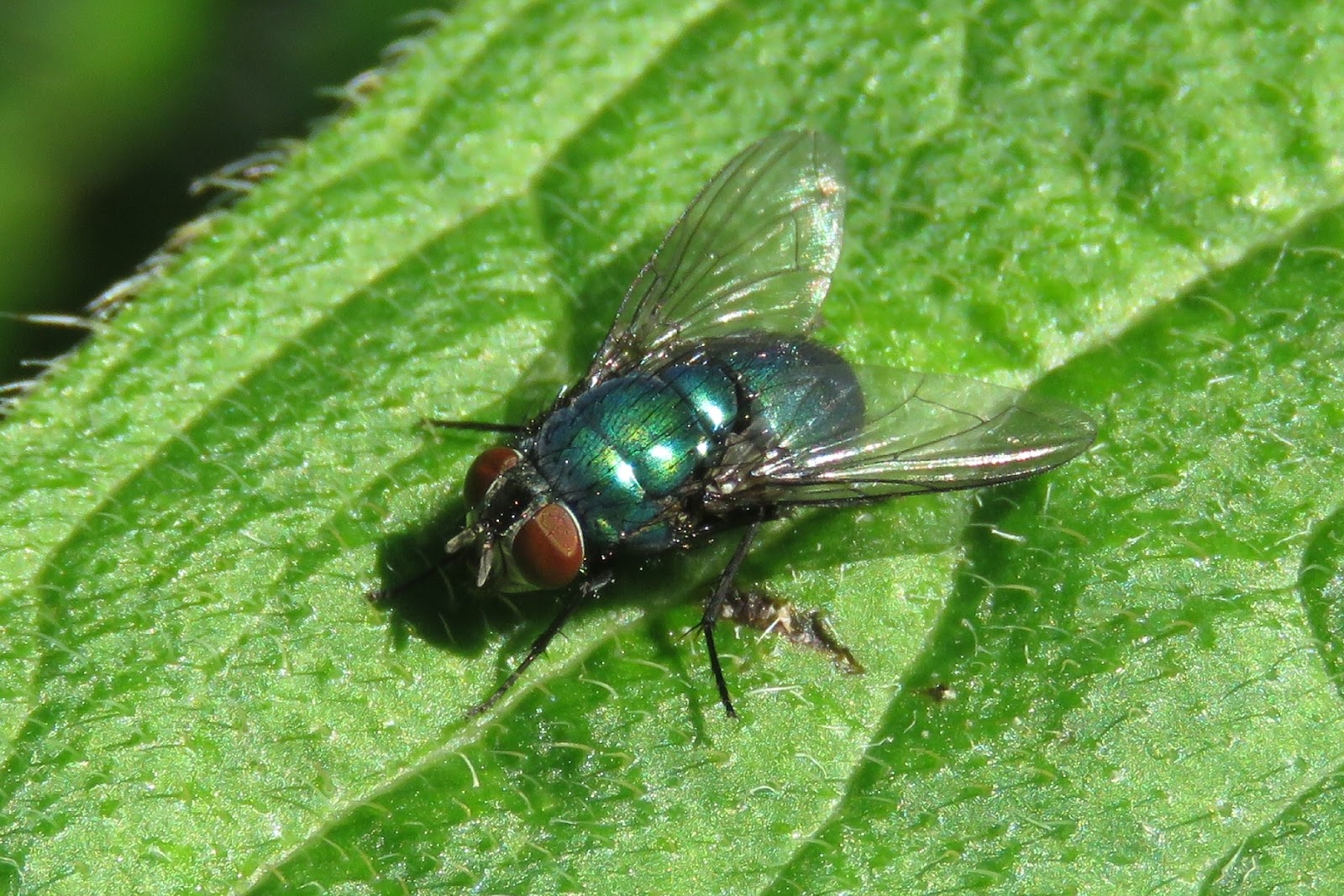
Down in the bottom where the valley runs back to native and wild there were still some Meadowsweet, Hogweed, Yellow Pimpernel and Red Campion in flower and I amused myself with some opportune fly watching and notched up a few species of Hoverfly with Episyrphus balteatus, Syrphus ribesii, Eupeodes corollae, Platycheirus  albimanus, Meliscaeva auricollis, Eristalis tenax and pertinax and Rhingia campestris. There were countless Cluster Flies, Green and Bluebottles and Flesh Flies and I found a nice Tachinid and several other as yet to be indentified species.

Pollenia sp - Cluster Flies

Cluster Flies paying attention to signage and two friends

Pollenia sp - Cluster Fly

Pollenia sp - Cluster Fly

Lucilia sp

Lucilia sp
Lucilia sp

Muscid sp

Not sure at all!

Sarc. sp - a Flesh Fly

Tachinid sp

Syrphus ribesii

Syrphus ribesii


Eristalis tenax


Eristalis tenax

Eupeodes corollae

Episyrphus balteatus

Episyrphus balteatus

Rhingia campestris


Speckled Woods and Red Admirals danced around and Migrant Hawkers, a single Southern Hawker and a few Common Darters were still actively on the wing.

Common Darter

Speckled Wood

Red Admiral


Great Black Slug


Back up at the top the Harvest Barn was a mouth watering display of fruit and veg from the gardens and the livestock seemed to be getting on just fine as usual!


The Hydrangeas were still in full flower and there was a superb display from white through various shades of blue to pink and burgundy. 


With more rain imminent I headed for the 50% off garden plant shop and wisely only left with a pot in each hand before the drive in truly atrocious rain back to Penzance with a brief stop for a picture of St Michael's Mount in a brief respite...

Thursday, 17 October 2019

Cornwall Day 2 & 3: 7th and 8th October 2019


7th October


Tawny Owl found its way onto my year list during the night but it dawned wet and dreary and a lazy morning slothing around the house was in order before venturing down into Penzance, ostensibly to visit the poundshop and get something for lunch.  It was foul out there with blowing clinging drizzle and so a return to the sofa and therapy Food Channel was required.

Penzance - looking towards Newlyn


Things improved at about half one so I made a dash for Porthgwarra where the pesky Red-eyed Vireo that was found after I left yesterday, was still prancing around.

A couple of pleasant but very frustrating hours ensued where I wondered up and down the valley not seeing anything vaguely Vireo-esque.  A smart silvery ‘acredula’ type Willow Warbler had me going when it popped out in front of me tail pumping and two Firecrests wre gleaning lazy flies from the ivy (amongst which were several much too big to tackle Mesembrina meridiana and a stripy Helophilus trivittatus!  

A delightfully insipid Great Black Slug

Mesembrina meridiana
Helophilus trivittatus

A single Chough headed up valley and a glance behind saw a White Stork standing forlornly on one leg on a rock overlooking the sea.  It looked rather incongruous and I presume it was one of the Knepp birds. 

White Stork


Suddenly there was a little flurry of activity and we joined others up at the Doctors Garden where the Vireo had shown for three seconds.  I waited and watched, altered angles and elevations but to no avail and had to be happy with a wing flicking Pied Flycatcher and a couple of Chiffchaffs before throwing in the towel for the evening. 


A pop into Tesco in Penzance added another two Firecrests as they moved through the car park with some Long-tailed Tits before I returned to camp for dinner and a beer.


8th October


The plan was to visit Newquay but as with all the best ideas, it not did not quite go accordingly and I ended up heading up the coast from there a little to the little hidden village of St Mawgan with the lure of the Japanese Garden there.

Watermouth Bay

Watermouth Bay

There were only a couple of other people inside and the gardens were still verdant and secluded and provided some interesting photo opps as well as adding Nuthatch to the list.


Giant Pond Skaters


Fly on coins left on the temple shrine and dogs

Eristalis tenax sheltering in the shop on a wind chime

Lunch was taken in Padstow or Crufts-on-Camel as I have renamed it. Everyone has at least one dog. There were packs on leads roaming the streets, dragging owners from pasty shop to Stein emporium. There shop owners here have no choice but to be dog friendly or they would simply have no customers at all stepping over the threshold.

From here I swept around to the A30 and back towards Penzance before diverting down to the Hayle. The tide was most of the way in and most of the birds were closer than yesterday. I counted 22 Med Gulls of various ages and picked up a couple of Common Gulls too. Three Grey Plover and 14 Sandwich Terns were new and there were now 21 Bar-tailed Godwits but I could not find the Osprey.  

2nd winter Med Gull

1st winter Med Gull and two Black-heads and a chunky 1st winter Common Gull

ad Med Gull
A Pink-footed Goose was with the Canada Geese on Ryan's Field but with little else to see I for some baffling reason  headed once again to Porthgwarra and where once again I failed dismally to see the Vireo! 

Pink-footed Goose and friend

My recompense this time was a last minute look out to sea which at long last added Fulmar and Manx Shearwater (the only one of each I saw all week), a pale Arctic Skua chasing a Kittiwake and the most delightful sight of 55 Grey Phalaropes strung out across the turquoise sea in three groups. They were a fair way out but looked superb in the low evening light as they bobbed and twirled and then took off in a snaky line to climb the crest of a wave before landing in succession and starting all over again.  Sometimes it is not about seeing things at point blank range where the minutia of detail can be discerned but the experience of seeing something absolutely in its element.  It actually made me smile and I ambled off to find the Heatherlea group to share them with.

Phalarope watching with Heatherlea - pic by Richard Moorhead 


With the sun still lurking I decided to end the day at deserted Pendeen with the intent of watching Sol dip behind the distant horizon. A Sooty Shearwater and seven Balearics were seen and a windblown Wheatear clung to the rock. 


However, after allowing me to take some arty shots with the lighthouse and some crashing wave action Sol went all shy again and hid behind a distant cloud bank with just five minutes to go! Pesky celestial body!


Monday, 14 October 2019

'Toot toot!' 14th October 1989

Like many birders of a certain age, the 14th October 1989 sticks in the memory.  The fact is that 30 years have now past since that fateful telephone call to Birdline in Westleton that sent us rushing (at Dad’s speed) to Holkham in the vain hope that we would manage to see Britain’s one and only Red-breasted Nuthatch.


I will let me notebook take up the story:


Paul Hawkins had joined my family and I for a day out birding in Suffolk and Minsmere was our first stop. We made our way around to the Island Mere Hide to look for a Great White Egret (I saw my first one here back in August 1984) but it was not there although there were quite a few Teal, six Pintail, and many Gadwall. The Kingfishers were performing well as usual, hovering motionaless for quite a long time before taking the plunge. Beardies were calling just outside while the highlight was certainly a Bittern which rose from the reeds, legs dangling before flying towards us and over the hide.


We didn’t  bother with the rest of the reserve as we wanted to move on quickly to Lowestoft (Eds: I presume for Purple Sands) but after phoning Birdline of course. Our plans slightly changed after this course of action... ‘Red-breasted Nuthatch – Holkham!!’ I nearly peeed myself in the telephone box after  hearing the news. 

A quick bit of parental persuading sent us heading in that direction. About an hour and a half later we were trotting down Lady Anne’s Drive with the dismal news that it hadn’t been seen for nearly two hours but no sooner had we arrived at its usual spot than it reappeared, albeit badly in a tree top where only the reddy brown underparts were glimpsed along with the dark through the eye.  The usual tense wait followed before it was refound.


Eventually after several better views, he came right out in the open on the top of a pine affording superb views for maybe five minutes. Everyone was ecstatic with clapping, cheering and laughing – such curious behaviour for a twitch.


The Nuthatch itself was a beautiful little bird. Nice sooty black cap, very long prominent supercillium, black eyestripe, grey bill, blue-grey back, darker flight feathers. Very short tail – blue-grey with black then white edges, white throat becoming buffier on the upperbreast then orangey especially on the belly and flanks then rich, bright reddy chestnut on the vent and undertail. The high piping call was not unlike – as the books say – a toy trumpet. It was a small bird, being only a fraction bigger than a Blue Tit. It was associating with a tit and warbler flock which also included a Yellow-browed Warbler.


Red-breasted Nuthatch was predicted yonks ago and I am glad they were right – what a cute little bird!

I have this image in with my photos and can't for the life of me remember if I took it that day or not - it is suitably bad enough to be one of mine but I suspect I am not crediting someone else so please do let me know!

We dawdled back towards the car enjoying  telling all the new arrivals tat he was still showing well. Back at the car we had lunch and watched a flock of 58 beautiful Egyptian Geese, hundreds of Canadas and Greylags and six White-fronts. Cley was to be our next stop and we spent the next few hours Seawatching where in between squalls we saw five Sandwich Terns, adult Little Gull, two Little Auks, 15 Guillemots, Red-throated Diver, three Long-tailed Ducks and many Kittiwakes and Gannets. Not bad I thought! Meanwhile ‘George’ the adult Glaucous Gull patrolled the beach and on one occasion came within two feet of us. What an evil looking bird. This wonderful day was rounded up nicely by seeing a Tawny owl at Fakenham as it passed ten feet over our heads.


Postscript: I returned four times after that fateful first day before last seeing it on the 18th March 1990.  I never missed it once and seemed to be able to pick it up on call as it quietly foraged with its chosen tit flock. Others with me were not so lucky and I am pretty sure one of them never connected at all. Will there be another one? Who knows but after 30 years it would certainly draw a crowd.