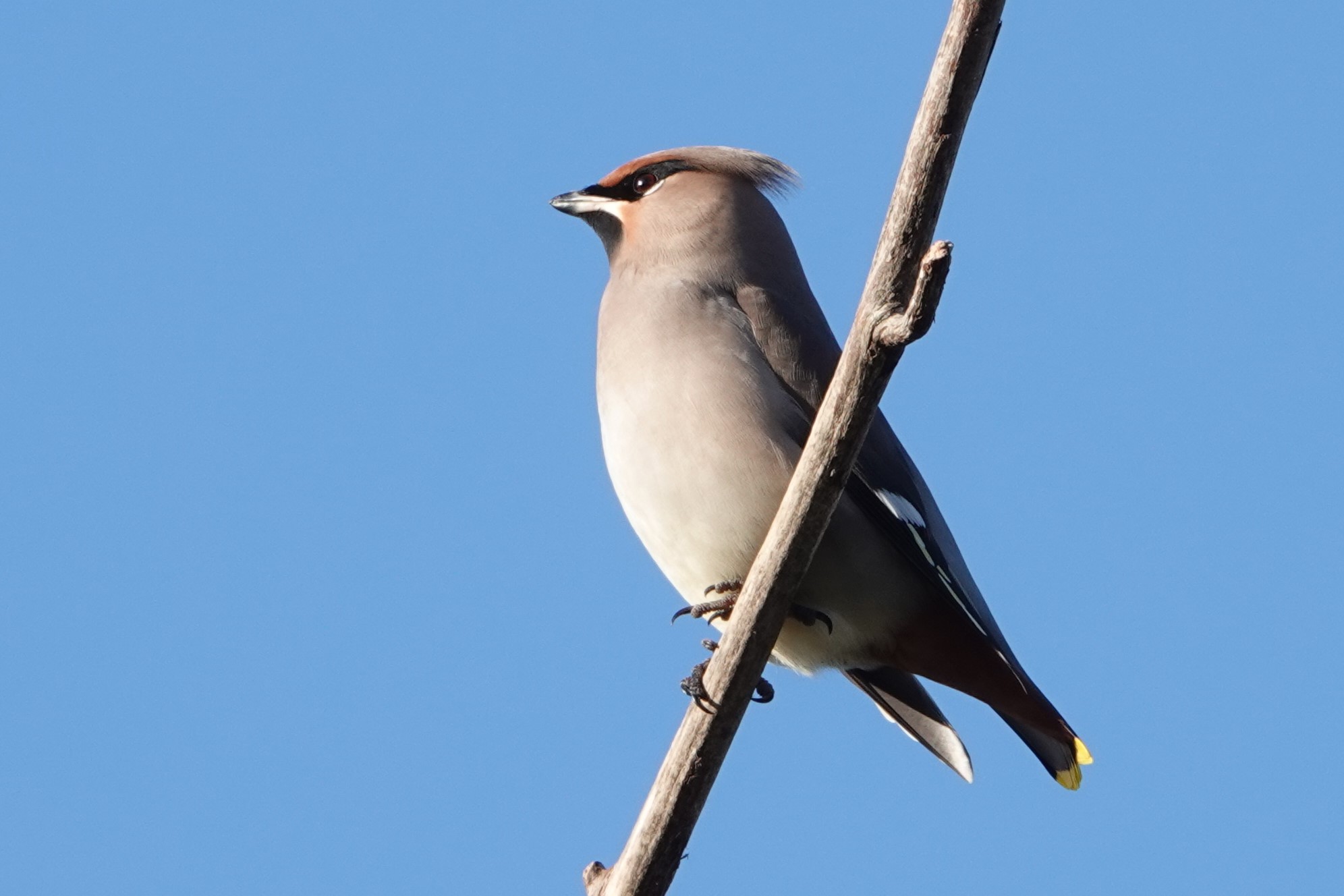
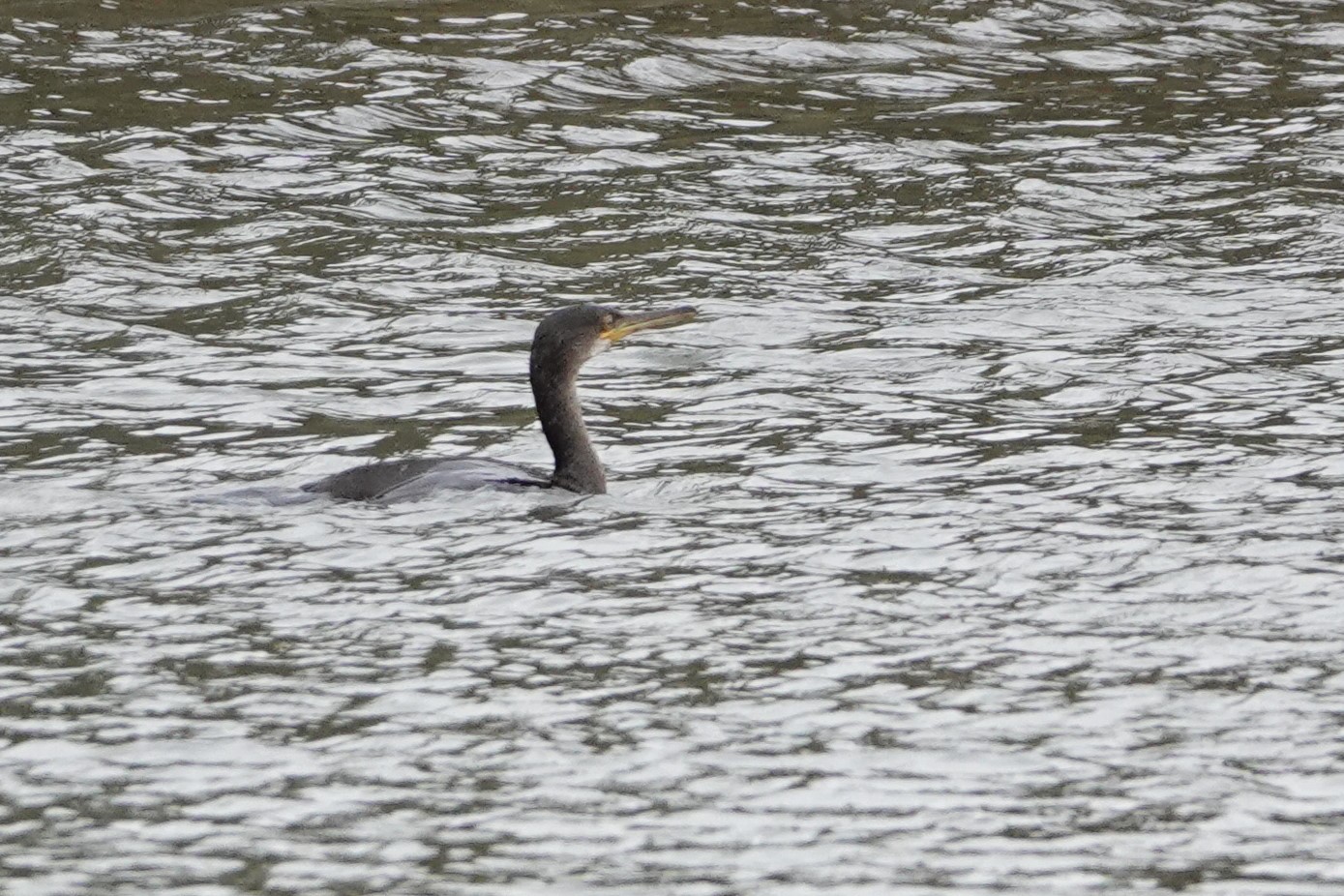
My BEB day out in Essex did not go quite according to plan and with not enough interest I aborted mission. However a dinner invite from the Jacksons in Thundersley had me deciding late on Friday night to just head down that way and see what I could find.
I had a good run down and started my day at Goldhanger where
hopefully the tide would still be coming in.
Siskins and Goldfinches flew over as I was getting my boots on and there
was a light Wood Pigeon movement south-west. Several Goldcrests were feeding win the conifers.
It was cold but sunny and there were already sunbathing
Calliphora vicina on the Ivy and a check of the same Bramble clump as last year
revealed three moth leaf mine including Ectoedemia rubivora.

Ectoedemia rubivora
The grumbling of Brent Geese reached me as I got to the
river wall and I could see them glinting in the awkward sun. The stubble field held Lapwings, Starlings
and a few small Gulls but something spooked the field beyond putting some
Golden Plovers, Rooks and Skylarks into the mix before it rippled across the
closer field.
 |
| Golden Plover |

The Black-heads and a few Common Gulls came low overhead and
with them a small gull. The underwing
confused me initially and caught me unawares and it was immediately lost into
the glare of the sun over the river. The
cogs whirred but it took a few minutes (no idea why!) before I suddenly twigged
that it had been an adult Bonaparte’s Gull.

Bonaparte’s Gull
One of those elated but frustrated moments. I think that it may be only the third for
Essex after the two inner Thames birds that were seen between Rainham and
Creekmouth. I put the news out but as
yet it has not resurfaced.
Poorly controlled dogs were a feature of the walk with
hounds running through the fields – unsurprisingly there was nothing to put
up. One such dog walker even asked why
there were not lots of Brent Geese in the fields this winter…
Turnstones were chittering around the seaweedy margins and I
could have sat and just listened to them and the tewing of Redshanks, whistling
of Curlews and the background Brents. The
river was rising and calm and the wavelets slapped softly on the concrete. I just needed to remove the shrill dog whistles,
‘chatting’ hounds and shouts of ‘Poncaby-Snuffle-Flumps III come back’ and it
would have been quite idyllic.
There were not too many waders roosting on the retreat but
amongst the shimmering flock of Dunlin there were a few plump Ringed Plovers,
Turnstones, Redshanks and Grey Plover and a few Knot and Oystercatchers whizzed
upriver towards Maldon.

 |
| Dunlin and Ringed Plovers |

 |
| Dunlin |
The Blackwater itself was quiet and the light challenging
but I still found nine Red-breasted Mergansers, 30 Great Crested Grebes and
fine partially summer plumaged Great Northern Diver which spent quite a bit of
time snorkelling.
Rock and Meadow Pipits nipped back and forth along with a
flew scissor tail flicking Reed Buntings, Linnets and chirruping Skylarks while
Cetti’s Warblers sang and chattered from the Dyke. A female Marsh Harrier was pursued by some
Rooks and a Kestrel hovered above the river wall. Two Green Woodpeckers
bounded along the hedgerows between Oak trees as I ambled back checking for more leaf mines before a well-earned cup of
coffee.
 |
| Parornix anglicella |
 |
| Stigmella oxyacanthella on Hawthorn |
 |
| Phyllonorycter oxyacathae |
 |
| Tischeria ekebladella |
 |
| Stigmella aceris |
From here I poodled back up to Abberton and stopped at the
small Billets screen where I bumped into Margaret and David Whitfield. Nine red-head Goosanders were seen in two groups
all using the same technique as the Great Northern Diver to look for prey. Three female Goldeneye and a drake Pintail were
noted but there were no other duck and no wild Swans yet with the Mutes. A single Redshank was feeding near the dozing
Lapwings while a Great White Egret stalked along the bank.
A party of Long-tailed Tits bumbled through the golden Field
Maple leaves alongside the road and a Buzzard watched from a telegraph
pole. The Whitfields suggested we all go
and get a coffee in the centre and so we headed that way and sat in the warm
watching a Red Kite circle by and a Moorhens and a Great Spotted Woodpecker
around the feeders. A Cetti’s Warbler
was seriously alarmed in the bushes outside and with a little patience it came
out and posed although we did not see what had so annoyed it.
 |
| Cetti’s Warbler |
A cursory glance out of the centre window at a raft of Pochard
would change the course of the whole day.
The light was great and although they were a fair way off I though it
was worth a look. Perhaps I could find a
Ring-necked Duck or a Lesser Scaup given the bumper American season we have
been having.
My second scan suddenly produced a strange but familiar head
profile with a huge ski-slope profile of a black bill. Surely that was not a Canvasback? The birds
were milling around and I had it in view for some time. It was bigger and
heavy, clearly paler than the Common Pochards, sat higher in the water, had a
long thick neck, pointy head and that amazing all black bill that narrowed
towards the end. I am allowed to say
this but the fact that the Whitefields could look in my scope from that range
and pick it out from the group made me even more sure that I had indeed got a
drake Canvasback.
At this point the whole flock got up and dispersed in several
directions and I had no idea where it had gone.
I phoned three of the immediate, in theory, closest birders and put the
news tentatively out on the local WhatsApp group.
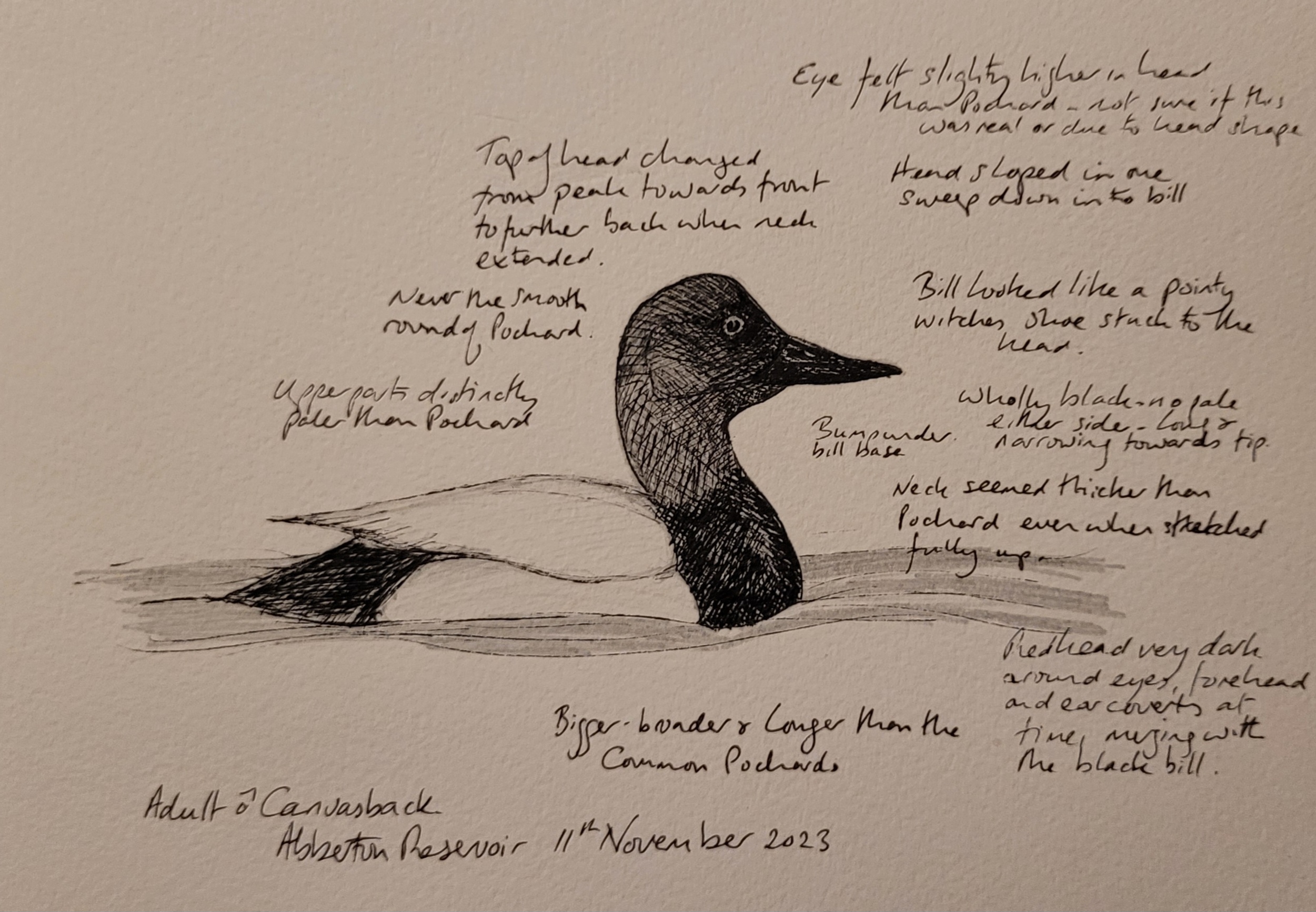 |
| Canvasback - a few little extra notes to add to this quick doodle late last night |
We set off to search from the hides as there was no point in
looking at the distant flock shimmering off towards Wigborough. From Island Hide a Great Northern Diver loafed
not far out but there were no Pochard.

Stan Davis and Ed Bateman were in the hide and Bradders soon
arrived. They headed back towards Gwens
and we went towards Hide Bay. Again
there were no duck save a few Wigeon and heaps of Gulls which included quite a
few Great Black-backed and a fine 1w Caspian but it was the Red Kites that
repeatedly produced the ‘wows’. An adult
and immature constantly patrolled the area just in front before occasional
sorties out to harass the gulls for any titbits that they might have
found. Certainly one of the closest Kite
performances I have ever seen.


 |
| Red Kite |
A male Stonechat was perched up on the dead weed tops and
two Chiffchaffs called from deep within.
I could see duck heading back towards Gwen’s so we wandered back and
joined the three lads to sift the incoming birds. A feeding frenzy soon developed and I can’t
ever remember seeing such a boiling mass of synchronised diving duck. Just how
any of them could see anything under the water but a thrashing mass of legs and
beaks is beyond me.


 |
| Pretty sure the Canvasback is in the middle back - big head! |
We were sure that it was not with them when Stan thought he
may have seen it close in with some of the birds taking a breather. A few
seconds later and it drifted into view for just a couple of seconds. I was so
relieved that I had not been seeing things.
Over the next forty minutes we all saw it on numerous occasions in the madness
of the feeding melee but usually for no more than a second or two at most.
 |
| Stan Davis |
 |
| Stan Davis |
 |
| One of mine - obscured but you can see paleness of the upperparts and flanks and the long neck and bill |
It always appeared bigger and heavier than the Pochards and the thick neck, big head and that amazing bill made it leap out once you had got your eye in. There was no way that any judgement could me made about mantle colour at this stage as when feeding none of the duck fully emerged from the water with just the front end visible before the next frenetic dive.

Dick Jeffree 
Amazingly my random melee shots coincided with it being above the water
A few
other Essex birders arrived and once they had all seen it I left them to it and
ambled back with a big smile.
Back at the centre I saw a female Marsh Harrier heckling the
flock and all 300 or so got up and spread out once again. Heading around to the Layer Breton causeway
added seven Cattle Egrets with cows at the junction and although there were plenty
of Aythyas between the causeways we could not find the Canvasback in the
lowering light. A Great White Egret flew
across on lumbering wings and Grey Wagtails headed off to roost while a
Kingfisher rounded up and magnificent day back on some of my old Essex stomping
grounds.
It was great to catch up with Annie and Barry over dinner
and in that increasingly small world in which we live, the adjacent table had
Bob and Jean Fraser on it. Bob used to
be a vol at RSPB Rainham Marshes where we worked and they now live in Worcester… what are the chances?
I had a good run home from there and was welcomed back by an
amazing starry sky as I reached the darklands north of Woodbridge.
******************************
Today the Canvasback was playing hard to get for the
assembled birders but eventually gave itself up between the causeways. This is the first since 2002 and only the 8th
for Britain pending acceptance and on that note I have, as expected, seen some ‘anti-duck’
bashing on line but to be honest this often happens with almost anything in
Essex, not just ducks. I have no idea on
what they are basing this but my primary concerns were whether it was actually a
Canvasback, whether we would re-find it yesterday and if possible were there
any signs that it could have been an escape.
I have had two confirmations today that both legs were seen (I presume
when preening?) and it lacks any leg irons.
 |
| One from Matt Turner today showing the contrast with a Pochard - and the little gular bulge that I noticed when I first saw it |
Let’s hope that it stays for the winter now and gives other
people the chance to encounter this imposing brute of a duck.