Tuesday, 8 August 2017

Insect Escapism


Over my nearly fifteen years with the RSPB I would say that the word 'stress' has seldom reared its irritating head but the last few weeks have been trying for a combination of reasons and thus, I have taken any given opportunity to immerse myself in the invert life that surrounds us on the reserve – it’s not that I have forsaken the delights of feathers – it is just that insects often hold me in their thrall this time of year when the seasons are on the cusp of changing once again.

Hen Harrier Day (more of that in another post) was on Saturday and took a huge amount of effort to prepare and host but even the mowing of the Wildlife Garden lawns reaped benefits when a beautiful Eyed Hawkmoth caterpillar dropped out of the Osier and onto the lawnmower that Andrew G was pushing around.

Eyed Hawkmoth caterpillar

It may not have been as huge as the Privet Hawkmoths we sometimes find (infact I thought it was a small one of these until Annie J correctly identified it) but it was a wonderful shade of lime green with yellow and white pointillism dots, rhubarb and custard spiracles and a pointy electric blue tail.

Eyed Hawkmoth caterpillar

What a beast! After a quick whizz around the centre for a show and tell session I placed him back on the Willow to continue on his journey but not before he had squeezed out the most ridiculously large hexagonal piece of frass! Now that had to smart...


The Echinops is now in flower and is attracting both Honey and a variety of Bumblebees but it is the two large Volucella hoverflies that lure me in with their striking colours and enormous yellow noses.

Volucella zonaria

Volucella inanis

Volucella inanis

After the exertions of HHD I took some time out on Sunday at the end of the ramp to chill and chat with the visitors which included Andrew Jewel who had popped in to drop off some book and then confessed to his love of Ladybirds. I merely mentioned that I had not ever recorded on the reserve the otherwise quite common 16-spot species and he said that he would see what he could do et voila – one was safely delivered to me in a little pot a short time later before being returned to its favoured Sea Beet clump.  Another tiny species, like the 22 and 24 spot species that he also found and looking very much like a number six dice.

16-Spot Ladybird - Tytthaspis 16-punctata

While waxing on about Ladybirds both Shrill and Brown banded Carders and the large black Andrena pilipes bees were feeding on the nearest crucifer.


And so to today where a short breathing space this afternoon allowed an escape for an amble in the surprising sunshine with a view to finding myself some insects and hopefully a passage Flycatcher, Redstart or the much fantasized Wood Warbler. 

Birdwise I may have drawn a blank but there was plenty to become absorbed into and with Jerry H and his trusty hand lens and net we had a pleasant hour in the Cordite area where Dasypoda hirtipes – the Pantaloon Bee were seen stuffing outsized pollen baskets on the Bristly Ox Tongue with slow flying Neomyia Greenbottles sluggishly moving amongst them. 

Dasypoda hirtipes
I know that I should not be even suggesting that I can id a different Greenbottle genus in flight but I suspect that that is the birder in me and I was actually correct each time I checked – sorry Phil, but at least it is thanks to you that I actually pay attention to them nowadays!


Hairs were counted and the pair of presutural acrostichial bristles and three pairs of postsutural dorsocentral bristles even allow the identification of this one to Neomyia cornicina. It is amazing what the brain retains.

Neomyia cornicina - bristles aside - the green betwen the eyes will at least get you to Neomyia rather than Lucilia
 
and this is a Lucilia sp....

Another fun little fly was the punky arsed Eriothrix rufomaculata - a tachinid who was so busy feeding that it did not notice that its buddy was being wrapped up by a Comb-footed Spider - Enoplognatha ovate.

Eriothrix rufomaculata

Enoplognatha ovate with dinner

Common and Holly Blues were numerous and I eventually found a Brown Argus while Speckled Woods were dancing in the trees. 

Speckled Wood

Jerry had caught himself a little Lasioglossum bee to study when a vivid blue hawker flashed through before turning round and flying straight back at me with wholly blue eyes blazing. I shouted ‘Blue-eyed hawker!’ and Jerry’s little bee was hastily put to one side. He is still trying to identify it...


He zoomed around for several minutes showing off his blue non-stripy flanks and generally vivid blueyness and regularly went up to battle Migrant Hawkers which had also suddenly appeared but he would not land and ended up disappearing over the trees into the Cordite. I later found several hanging Migrants but not this blue eyed beauty.

male Migrant Hawker

female Migrant Hawker

female Migrant Hawker
David Lee also saw one on the northern Trail on Friday and his shots capture the brilliance of this species.


David Lee's BEH from Friday...

Brown and Southern Hawkers were also patrol but as usual the former never seem to land while Ruddy Darters predominated amongst the Sympetrums with only one Common seen.

male Southern Hawker
male Ruddy Darter

male Ruddy Darter

female Common Darter

We found several more Volucella zonaria on territory and a nice plump Eristalis tenax with the hairy eye stripes, the furry white bummed Eristalis intricaria (who is one of the most consummate of hovering hovers) and the black and yellow wasp-like Chrysotoxum festivum.

Eristalis tenax

Wasp Spiders, now fat and round, had laid their traps in the taller areas of grass but I suspect that the forecast rain tomorrow will cause a few problems for them.

Wasp Spider

Dark Bush Crickets chirped from the undergrowth but I caught one out on a bench and sewing machine Long-winged Coneheads seem to now be the commoner of the two species present on site.

Dark Bush Cricket

I left Jerry to continue on his way round to lock up and pottered back on the return loop munching a few specially selected Blackberries and day dreaming of a good night’s sleep.

Tuesday, 1 August 2017

Late to the party...

RSPB Cliffe Pools 31st July 2017

I had  a couple of hours spare yesterday morning and after a failed doctors appointment I headed down to RSPB Cliffe Pools not so much for the chance of the Marsh Sandpiper but primarily to see the two families of successfully fledged Black-winged Stilts on the pools by the Black Barn.


I risked the track down there in the new wheels and stopped first to check out the radar pool for the Sandpiper.  It was already quite hazy and although I did find the Marsh it was way off. Greenshanks either dozed on the banks or raced around like loonies with up tilted bill tips scything through the water but it was otherwise quiet.
Flights of Black-tailed Godwits were still coming on off the Thames but there were no caladrids to check through.


Once at the view point I was immediately aware of calling Stilts and over the next hour I enjoyed watching seven young and at least two adults feeding actively just below me in the shallows.


What a magical sight and testament to the effort put in by my colleagues and their volunteers over the weeks leading up to the hatching.


Having only seen day old chicks before  (that never lasted long) this was a real treat. Like may species the juveniles call was nothing like the adults being a soft plaintive piping. They looked really odd in flight too with shorter trailing legs, brown scaly appearance and white trailing edge to the wing. They actually looked more like an odd Greenshank.


Common Sandpipers and Avocets shared the pools and a Spoonbill preened on a distant island while Beardies pinged around me to round off a pleasant escape.


I am glad I got to see them at last and to bear witness to the start of what may hopefully one day become common place...

Sunday, 9 July 2017

RSPB Rainham Marshes Rambles - July 2017


With some fair (swealtering) weather reappearing this week, I took the opportunity to escape out onto the reserve for several short walks, mainly with insects in mind although it was nice at last to connect with a Green Sandpiper for the old year list! Normally I get one in January so it was good to finally see that flashing white rump and ‘twit – whit ‘call.


A wander up over Rainham Ridge revealed the first Gatekeepers of the year along with countless Meadow Browns, the two smaller Skippers and a few Red Admirals and Painted Ladies all feeding merrily on the blooms of Mallow, Thistles, Yarrow, Bristly Ox Tongue, Wild Carrot and new one on me, Dittander - Lepidium latifolium while the Perennial Sweet Pea with its shocking pink flowers was being enthusiastically raided by bumblebees of at least four species.

Painted Lady
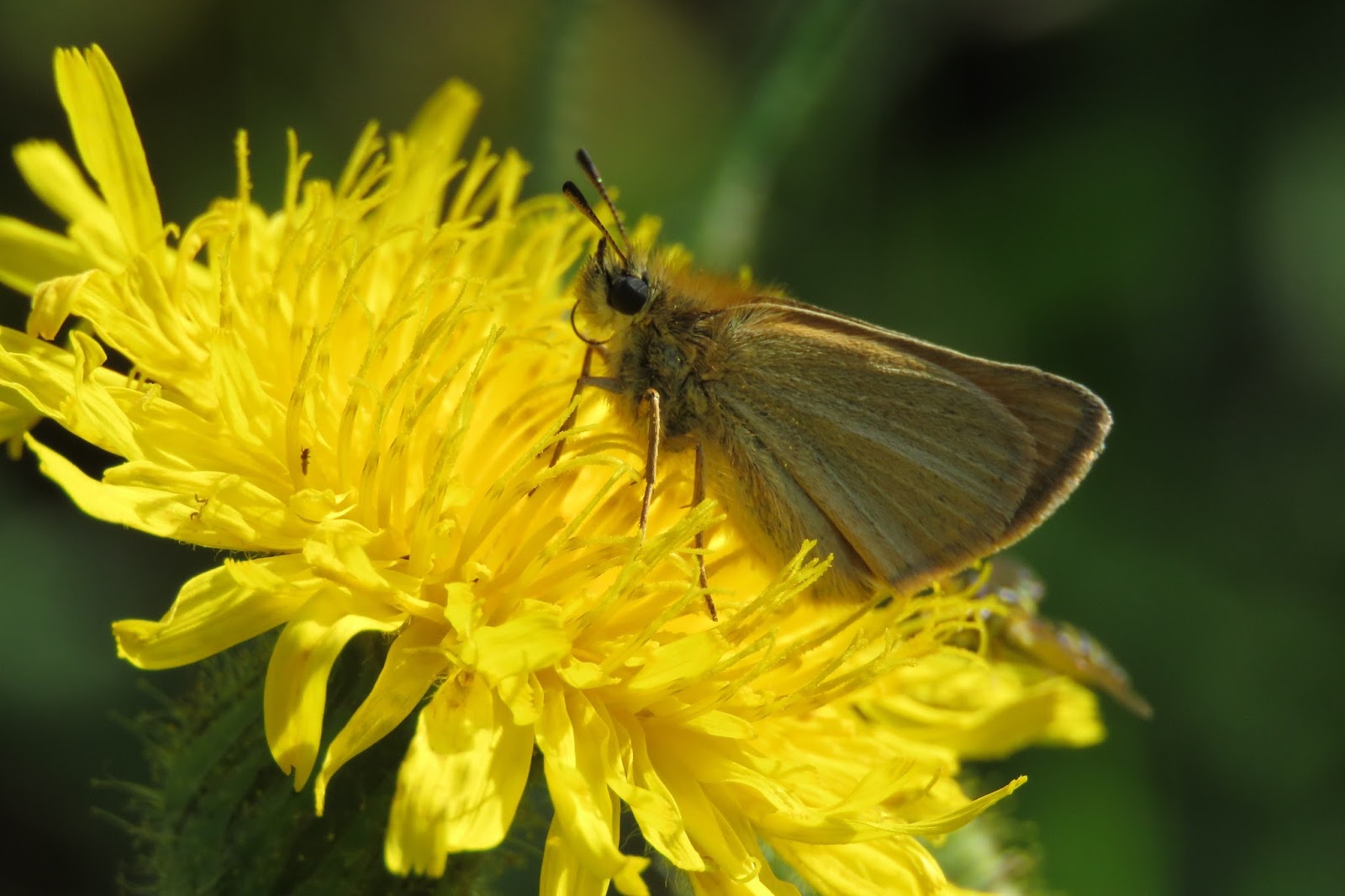
Essex Skipper
 
Small Skipper
Essex Skipper


Gatekeeper


Meadow Brown

 
Common Mallow
Yarrow


Wild Carrot
Perennial Sweet Pea


Perennial Sweet Pea
Dittander - Lepidium latifolium


Red Soldier Beetles were similarly gleaning and as usual were often in flagrante delicto.


Skylarks were still in song from both perches and the air above my head and Meadow Pipits were collecting food for that all important second brood while flocks of mainly juvenile Starling whirled but did not murmurate – over the tip.


Skylarks above and below
Starlings

July sees the start of our annual Stock Dove congregation and small groups exploded grouse-like from cover as I ambled along and out on Wennington I counted at least 60 in one flock.

Stock Dove


Large Flowered Evening Primrose, Great Mullein and Ragwort (complete with Cinnabar cats) added more yellow to the pallet.

Large Flowered Evening Primrose
 
Ragwort

Cinnabar cat
Great Mullein


Closer to the visitors centre we have regularly seen Marbled Whites over the last week which is great news and hopefully this small number may see the start of this species colonisation of the site. They are particularly fond of the Black Knapweed but they seldom stay still for long and are a bugger to photograph so I was pleased with this shot.   

 
Marbled White
The first Clouded Yellows and fresh Common Blues, Brown Argus and Six Spot Burnets are making this a very attractive spot but the swathes of Bedstraw and Trefoil are nearly over and it will be the Yarrow, Creeping Thistles and Bristly Ox Tongue that will become popular.

Common Blue
 
Six Spot Burnet
Brown Argus

Brown Argus
A Six-belted Clearwing moth was vying for a spot against a Wool Carder Bee on the Trefoil and the Honey Bees were making the most of the abundant nectar.

Wool Carder Bee on Lemon Balm in the wildlife garden


The first Brown Hawker was on the wing on Monday and Southern Hawkers are now patrolling the woodland pathways and picking off smaller aerial prey while down in the grass Wasp Spiders are growing fast and taking on anything silly enough to leap into their strong webs.

Southern Hawker
 
Southern Hawker

Speckled Bush Cricket

The Lavender is covered in bumbles and in the wildlife garden the Wool Carder Bees are firmly on territory while Willoughby's Leaf Cutters are using the bee boxes we put up.  the blooming Chicory at the end of the exit ramp is also attracting the first Hairy Legged Mining bees - Dasypoda hirtipes of the year as they fill up those enormous baskets on the rich white pollen.

Wool Carder Bee
Hairy Legged Mining bees - Dasypoda hirtipes
Bumble on the Eryngium

Bumble on the Eryngium - a bit pale so not sure of species
Some concerted bee work around the gardens and car park has added Hawksbeard Mining Bee- Andrena fulvago to the list as well as the superbly green-eyed Anthophora bimaculata which zooms around like it has its own built in nitrous oxide button. The latter is pretty scarce while the suitably named Spined Mining Bee – Osmia spinulosa was collecting pollen from the Fleabane with a superb Red Tipped Clearwing - Synanthedon formicaeformis for company. 

Spined Mining Bee – Osmia spinulosa -
 
Red Tipped Clearwing - Synanthedon formicaeformis


Huge, territorial Volucella zonaria are now taking up their spots in the woodland too and having our biggest – and completely harmless- hoverfly eyeballing you from six inches is quite an experience. At least a dozen other species have been seen including the spotty eyed Eristilinus sepulchralis and incredibly wasp-like Chrysotoxum verralli. 

Volucella zonaria
 
Eristilinus sepulchralis
Chrysotoxum verralli - and yes I did work out antenna segment ratios after I potted it!
There are many more Episyrphus balteatus around this weekend and I suspect there has been an immigration of this migratory species as I also found my first, and always impressive, Scaeva pyrastri nectaring alongside them and Eupeodes corolla.

Episyrphus balteatus on Chicory
 
Scaeva pyrastri

Eupeodes corollae - female
 
female Sphaerophoria sp - nice but unidentifiable
There has been an explosion of Peacocks and the buddlias are now home to many flashing eyes as well as Red Admirals and Commas and Oak Eggar Moths are careening around at warp speed.

Peacock

Red Admiral

A White-letter hairstreak was seen on the path on Monday – the first for several years – and I was lucky enough on Friday to see one briefly but our nice patch of sucker English Elms are out of reach to even us to check to see if we have more.

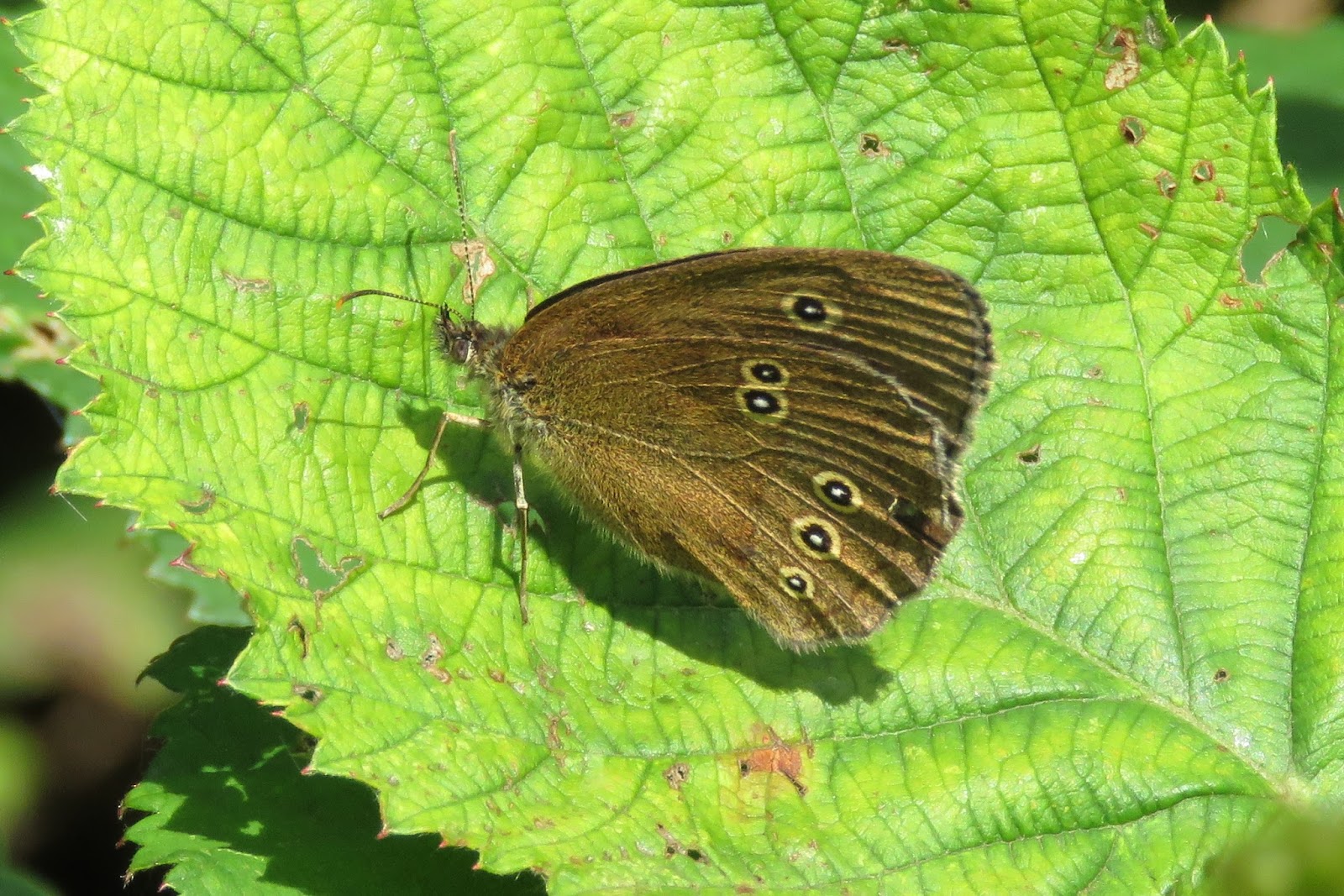
Ringlet
The remaining Hogweed flowers ares still attracting flies including two Cheilosia species - illustrata and pagana as well as plenty of Green and Blue Bottles and Red Soldier Beetles.

Cheilosia pagana
Cheilosia illustrata
Cailphora sp

Cailphora sp

Lucilia sp
Soldier beetle

I was going to end on a Gasteruption jaculator but I have already done that gag...

Gasteruption jaculator

Last year we caught several individuals of a rare and protected fly on the reserve.  The Levels Yellow Horned Horsefly - Hybomitra ciureai - has only been reported once or twice in Essex but I have caught four more since last Saturday so it is obviously doing well.  

Levels Yellow Horned Horsefly - Hybomitra ciureai
And before you ask, yes she can bite but on our marsh it only seems to be the Clegs that persistently try to draw human blood...
Just look at those amazing compound eyes!

Levels Yellow Horned Horsefly - Hybomitra ciureai