Saturday, 25 February 2023

Four Days in East Anglia - Day 2 - 22nd February 2023

A www.blueeyedbirder.com weekend away...

An early start from Wymondham saw us convene at a very grey East Bank at Cley at 8.15am.  It was quite still but already drizzling but Wrens, Reed Buntings and Cetti’s Warblers were already proclaiming the morning in and five Grey Herons lumbered off inland after an early breakfast.


The Wigeon flock was enthusiastically grazing the closest area of freshmarsh with a few Teal but there were no waders at all on the Serpentine and it looked like once again the Dowitcher would be problematical. Three each of male and female Marsh Harriers patrolled the reserve reedbeds with some suggestion of territorial patch owning by the tricoloured males.  They spooked a Spoonbill from the scrapes which headed quickly west to be lost in the increasing murk.

Down on Arnold’s Marsh there were just a few birds to look through with three Black-tailed Godwits, five Grey Plover, 13 Dunlin, two Turnstone and a few Redshank and Oystercatcher while on the pool the other side of the path there were dabbling Pintail and Gadwall as usual. There must be something particular about the conditions at this spot for these two species.

As we reached the beach a flock of Snow Buntings bimbled east over our heads so we set of in that direction to where we had seen them land.  The drizzly became light cold rain at this point which did not help. The Buntings had vanished by the time we got down to the sea pool but a fortuitous scan produced a flock of 13 Twite that appeared on a fenceline with just enough time to get the crew onto them and see the pale wing panels, dark plumage, peachy fronts and pale (at that distance) bills.  They dropped down and we moved closer but could not find them again in the miserable conditions.


The Snow Buntings returned at that point, circled us and then went back whence they had come and so did we.  The shingle held the first leaves of new Yellow-horned Poppy and Sea Campion and there were some vibrant lichens to be seen.  

Snow Buntings 

Yellow-horned Poppy - Enid Barrie

A fabulous lichen and a little bit of Mossy Saxifrage top right - Enid Barrie

Xanthoria parietina - Enid Barrie


Out to sea there was, well, some sea.  It was almost devoid of life with just a few big gulls moving through, three Gannets of different ages and three Avocet that were the first of 16 that came into the pools where some more Dunlin and scuttling Ringed Plovers were now to be seen.

A murky Cley Windmill - Nikolaas Reuther-Hols 

The Barn Owls had been busy in the Arnolds Shelter


Brief Bearded Tits and a trilling Little Grebe were added on the return walk and the Teal not engaged in vigorous display were busy squibbling in the muddy margins and could be heard clearly from some way off!

A comfort break at the visitors centre where the Marsh Harriers put on a much closer display and then westwards to Stiffkey for a walk along the grey coast towards the gibbet. The saltmarsh was covered in hundreds on Brent Geese and I suspect that the super high tide had left strandlines of seeds that they were capitalising on.  I spent much of my time scanning for Black Brant but had no joy. 

Brent Geese 

A Great White Egret was feeding off towards East Hills and Little Egrets liberally dotted the vista along with a few Brown Hares.  Two Marsh Harriers were the only raptors seen on the entire visit. 

Arty Brown Hare in saltmarsh habitat with East Hills behind


Curlews and Redshanks probed the pools and a few Pink-feet were seen ‘winking’ along the coast.  I was hoping for some small birds in the game crop but it was very disappointing with just a couple of Linnets, Green and Chaffinches seen and it feels like birds have already began to move on as Spring looms somewhere through the dank greyness.

Alexanders was beginning to flower and a movement in the leaves produced a poorly young Common Gull that I ushered back out onto the saltmarsh where a half hearted flight was attempted but although unwell it was going to be better off out there that on the path to be snapped up by a passing hound or Fox. 

Alexanders

Common Gull 

Curlew - Nikolaas Reuther-Hols 


The rain returned and we sat in the cars for lunch and then moved on once again to North Point Pools where the weather was kind to us for the rest of the afternoon.  The east pool was covered in Lapwing, Curlew and Black-headed Gulls with Wigeon and Teal grazing around the edges. The west pool had more duck and a collection of Greylags, Brent and Egyptian Geese while many energetic Brown Hares lolloped between the fields in engaged in half hearted sparring matches.


The Barn Owl was hunting the same patch of scrub as a few weeks ago which was pleasing given the breeze but soon disappeared back into the Hawthorns.  We traipsed up the path through the high field once again for the view and also to see how the flora we discovered was coming on.  The periscopic heads of Coltsfoot were pushing through in vast numbers and I can’t ever remember seeing so much in one spot.  Most were just opening with one or two fully seeking the sun and in the next few days the lower half of the hill will turn yellow.  Some of the Dense Flowered Fumitory was now in flower and we also found Groundsel, Field Speedwell, Chickweed, Shepherd's Purse, Scentless Mayweed and Red-dead Nettle in bloom with Field Pansy and Marsh Cudweed on the way. 

Barn Owl 

Coltsfoot

Coltsfoot

Dense Flowered Fumitory

Marsh Cudweed

Mertzneria lappella in Burdock seed heads again 


The vast flocks of Linnets and Skylarks had dispersed but the air was still full of Skylark song and a Yellowhammer wheezily sang in the hedge.  Brent Geese moved over and into the pools for a freshwater drink before heading to a favoured field to graze with the Greylags and a solitary Barnacle Goose while a couple of thousand Pink-feet were feeding noisily behind the town and visible as a goosy cloud that appeared above the rooves every now and then.  A Raven kronked its way along the coast and I am pretty sure that this was actually a new Norfolk bird for me.


Pink-feet

Brent Geese

Mixed Geese

Oystercatcher - Nikolaas Reuther-Hols 


Two Water Pipits were flitting around but refused to be found on the deck and a Chiffchaff called stridently from the bushes as we slowly ambled back to the car with Red Kites and Buzzards drifting over the inland countryside.
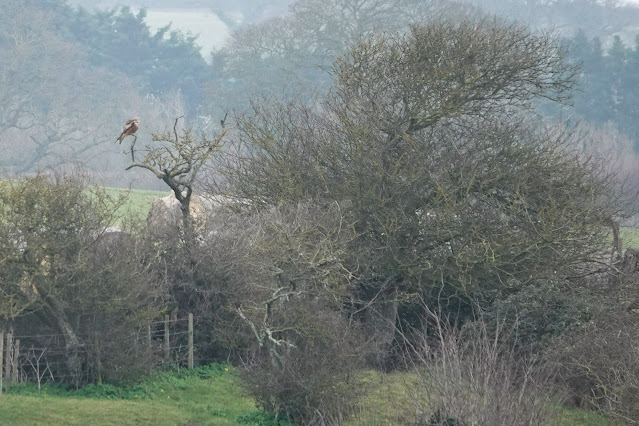
Red Kite

Red Kite

Red Kite


The Brown Hares were once again partaking of the zoomies with madcap dashing as we packed up for the day.  It may have been grey and a bit damp but any day birding on the Norfolk coast has its rewards.

On the way back to drop Joan off in Burnham Deepdale I stopped at the usual layby to scan the west end of the Holkham and BO Dunes freshmarsh and within just ten minutes had seen two more Barn Owls and Great White Egrets, two ‘ kerrickking’ Grey Partridges, the usual big three of raptors and about 30 Barnacle Geese with both Muntjac and Chinese Water Deer in the same view to round off proceedings.  I hoped that the weather would be kinder the following day for an evening visit.


Friday, 24 February 2023

Four Days in East Anglia - Day 1 - 21st February 2023

Another planned weekend in Norfolk saw me heading up via Suffolk on Tuesday morning.  It was an uneventful drive with just a few Buzzards and two Red Kites of note before I got to Carlton Marshes early afternoon. It was quite still and ended up being a glorious walk with the sun behind me and an illuminated marsh in front. 


It was very much as my first visit back on the 10th with good numbers of all the dabbling ducks and actively feeding flocks of probing Black-tailed Godwits and Snipe.  The odd Godwit was starting to colour up with a few barred chestnut feathers starting to appear.  Two Oystercatchers piped overhead as they dropped into Petos and were shortly followed by a pair of Med Gulls that could be heard calling long before they came into view on gleaming white wings. My quest for the pesky Eastern Yellow Wagtail ended in frustration though as I heard it call twice but could not pick it up. Nevermind. 

Black-tailed Godwit demonstrating distal rhynchokinesis


Wigeon


Shoveler, Teal, Snipe and Dunlin

Med Gull

Med Gulls


I found two Water Pipits and amongst the Lapwings there were three Dunlin and three Ruff with one of the latter being blinged up to the hilt.  Another birder on site was going to submit the details along with those of the colour ringed Godwits seen.

Three Great White Egrets were stalking the margins but I contrived to miss the ringtail Hen Harrier that flew under my nose! As I ambled back it was good to catch up with the Greens and Prestons and I left then to continue to search for the Wagtail – saying that it would undoubtedly appear once I got back to the car which of course is precisely what it did.

Punked up Little Egret

Great White Egret - already with pale legs

Great White Egret


As the evening approached the Wombat faced Chinese Water Deer rose from their slumbers in the grass and started to wade about and graze and I even found the same buck with the mis-matched canine as before.  A Chiffchaff called stridently and Water Rails and Cetti’s Warblers became vocal while the odd Reed Bunting was in hesitant song.


Chinese Water Deer 

Chinese Water Deer 


I walked back with Marsh Harriers quartering the marshes and the Barn Owl appeared in exactly the same spot as ten days ago as a nice send off while a full breeding plumaged Grey Heron patently stalked prey in he closest ditch and glowed in the low light while a Muntjac fed quietly just a few paces further on.

Barn Owl 

Muntjac

Grey Heron 


It was time to move on and a casual glace at the Hollow Grove Rowan tree revealed those two pesky Waxwings that I had repeatedly missed perched up on top but I could not pull over and had to be content with drive by punks on my way to Wymondham.  It was a pleasant hour cross country with more raptor action and a Great White Egret on the marshes at Beccles.

Monday, 20 February 2023

Kentish Nature Walk #67 - The Ranscombe Loop 20th February 2023

A www.blueyedbirder.com day out...

My first scheduled Ranscombe walk of the year started well with a fine adult Med Gull on the playing fields just minutes after meeting up with Malcolm for our walk.  It was metal ringed and well on the way to full summer plumage. A dog walker spooked the flock and so we moved on to the underpass and onto the loop.

Med Gull


Bullfinches were calling as soon as we crossed the railway and just for once perched up, albeit distantly in a Hazel.  The first Coltsfoot was in flower and on closer inspection there were still some tiny red anemone Hazel flowers to be found.

Bullfinch

Hazel flowers


The Lady Orchids were poking through the Sweet Chestnut leaf litter and the adjacent clump of Butcher’s Broom was coming into flower if you looked really closely. King Alfred’s Cakes glistened on trunks and Lords and Ladies were twisting into view.  It was quite warm but still breezy and I think just not quite right to entice any insects to come out and bask.

Butcher’s Broom

Lady Orchids

King Alfred’s Cakes

Lords and Ladies


Skylarks were singing in the fields above The Valley and gangs of Rooks and Jackdaws swirled on the gusts with two Buzzards for company.  The woods were still very dormant and even the resident birds seemed reluctant to make themselves known. Primroses were just starting to open on the path side and the Holly was likewise in bloom with its waxy almost pinky flowers.  There were still some berries on the Privet that had evaded snaffling by the Thrushes and the Spurge Laurel was in fine flower but as usual was scentless.


Primroses

Holly

Spooked Wood Pigeons

Privet

Spurge Laurel


I fondled some Burdock seed heads but found nothing to suggest moth larva presence but found none but had better luck with Endothenia within several Teasel heads but I chose not to spend time check for the presence or absence of anal cones to tie them to species!

Stigmella aurella

Stigmella aurella (left) and Coptoptiche marginea (right). Learn these two on Bramble and you will find them almost anywhere you look

Endothenia sp within its poo cocoon...


We descended across Kitchen Field with Raven and male Sparrowhawk in the now blue sky and two Meadow Pipits unusually perched atop the dying Ash trees which were adorned with garlands of silvery Old Man’s Beard.  A Green Woodpecker loudly yaffled before actually perching up for a short while and flashing that red crown.

Old Man’s Beard

Raven


A party of four stag and two hind Fallow Deer were in their favoured secure meadow and watched us cautiously.  The stags looked in fine fettle.  


Fallow Deer


Up into Brockles where the view across the valley revealed the hideously fake green of thousands of vine guards and another Sparrowhawk and Kestrel were added as we followed the path up alongside the woods.


Malcolm found three Stonechats in the next meadow which had not been cleared of scrub saplings yet which was pleasingly on my second record for the site.  Two males and a female were working the field and we moved a little closer in the hope that a Dartford Warbler may have chosen to join them but alas not!  Mistletoe had obtained its almost luminescent spring colours and the flowers were just starting to open.  It looks so different at this time of year.


Mistletoe

Stonechats


A coffee on a log afforded fine views and the sound of Skylark song descending from up on high before we cut through and followed the Cobham fenceline where Bluebells were showing their new leaves to the fields where a pair of Mistle Thrushes were seen as we popped out into the open. A single Celandine flower was home to an Episyrphus balteatus in all its stripy glory and there were a few lazy Calliphora vicina basking on fence posts but no Bees or Butterflies.


Celandine

Episyrphus balteatus

Spears of Bluebell leaves


Back into the Cobham Estate woods where Long-tailed Tits foraged and a Treecreeper did what they do best while we walked down to say hello to the Highland Cattle that were chilling out in the dead Bracken. The first furry Yellow Dung Flies of the season were staking out a nice fresh pat and one male was already paired up!


Yellow Dung Fly


Just chillin'


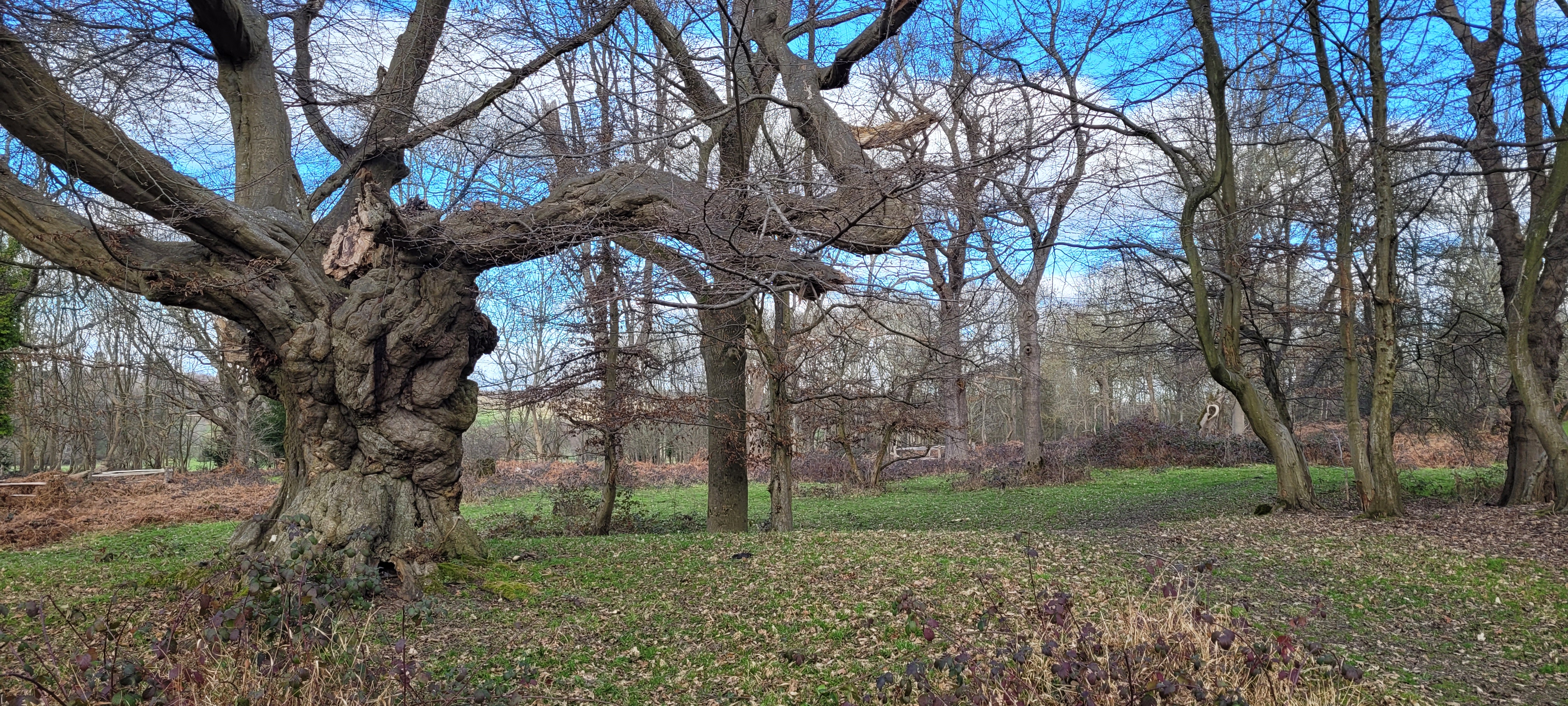
We walked through the hollow Chestnut and then back onto the main drag back to the cars introducing Malcolm to some of my other favourite trees on the way.  As usual the downhill route back was much appreciated but the woods were quiet bar from a few foraging Tits and a Goldcrest just before we crossed back over the Eurostar line after a pleasant five mile circuit.

I used to call it the Elephant Tree for a shape in the charcoal insides but it would appear to have developed other elephantine proportions over the winter months...

The Hollow Chestnut


The aftermath of the October 1987 storm is still evident in the winter months with the aligned trunks of the massive Chestnuts that did not make it through. Some are dead but most still have a toehold in the stony ground and now have 35 year old regrowth from their horizontal original trunks while others have Birches growing out of their remains.